

If you ask a structurer what they want from a pricing platform, the answer is likely accurate prices on any product in the book, without a model-selection exercise bottlenecking every trade.

From left, Oumayma Zinoun and Matthieu Charrier. (Photo courtesy of Cegaware)
For most desks, the calibration of volatility surfaces is a standing compromise (acknowledged or not): either the parameterisation is rigid enough to guarantee no-arbitrage, and a worse fit to market is accepted; or it is flexible enough to track the bid-ask, and arbitrage risk is accepted. genOTC’s calibration methodology removes the need for that compromise, it’s also why Cegaware has incorporated genOTC into its pricing platform.
Cegaware’s team knows the compromise firsthand. “Our standard was the Robust SSVI parameterisation from Gatheral and Jacquier. After extensive testing on several stocks, it is arbitrage-free in 100% of cases. From that angle the problem looked solved,” says co-founder and CTO, Matthieu Charrier (formerly BNP Paribas). “But the price was too high. Robust SSVI is rigid. It imposes a shape on the smile that does not always match what the market is actually quoting.”
The team tested the alternatives: standard SVI, Vanna-Volga, SVI free wings.
Each tracked the bid-ask more closely in certain regimes, at the cost of higher arbitrage risk where constraints are hardest to enforce. “Every parameterisation we tested made us choose between fit and safety. genOTC was the first calibration we evaluated that didn’t ask us to choose.”
Every parameterisation we tested made us choose between fit and safety. genOTC was the first calibration we evaluated that didn’t ask us to choose.
Launched in 2025 and based from the DIFC Innovation Hub in Dubai, Cegaware is a cloud-native SaaS platform to book, price, and monitor portfolios of financial derivatives and structured products. Their coverage today spans equities, FX, crypto and some rates products, with full rates support, including volatility calibration, on the roadmap (Structured Retail Products, April 2026). “The idea came from a simple frustration: the tools existing today are expensive, rigid, and built on decades-old infrastructure,” says co-founder and CEO, Oumayma Zinoun (formerly TotalEnergies).
“Institutions spend millions on systems that take months to deploy and offer little flexibility for teams who want to build their own workflows on top.“
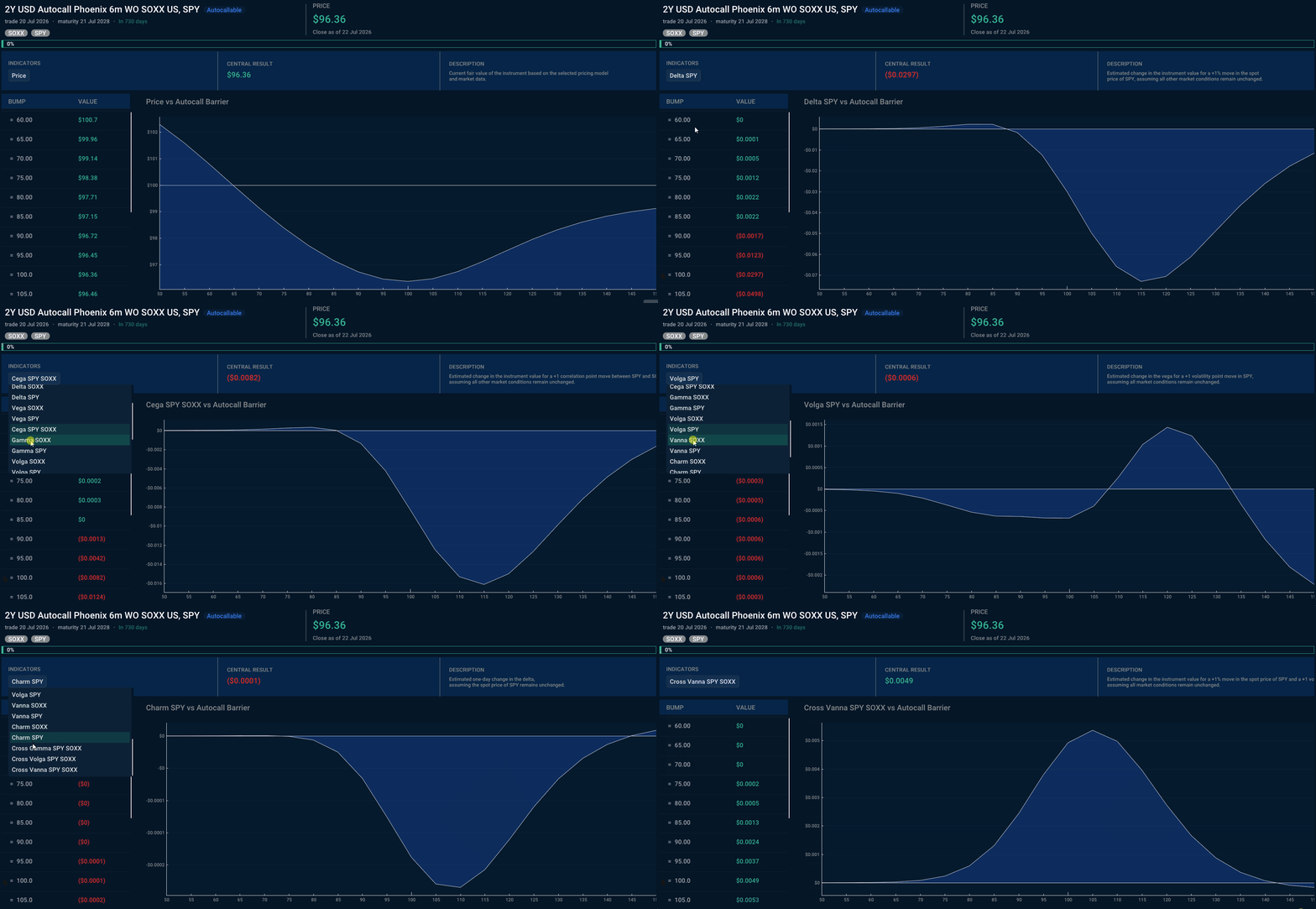
A two-year USD autocallable Phoenix note on the worst of SOXX and SPY, priced at $96.36 as of the July 22, 2026, close. The chart shows note price against the autocall barrier under spot bumps from 50% to 145%, with the price crossing par near the 65% bump level. Cegaware pricing based on genOTC calibrations. Animation courtesy of Cegaware.
From a single platform, users price and track positions in real time, run market scenario simulations, analyze sensitivities to underlying instruments and create new deal structures. Technical teams integrate through a documented REST API; everyone else works in a web application with interactive dashboards. In the co-founders words, the Cegaware pitch:
- faster deployment
- lower cost
- modernized infrastructure
One capability the founders deliberately left to a specialist: calibration. “Volatility surface calibration at that level of precision is a specialization in its own right and genOTC is simply better at it than we would be if we tried to build it ourselves,” says Charrier.“That is the best example of how we work. Do what you are great at, partner for the rest.“
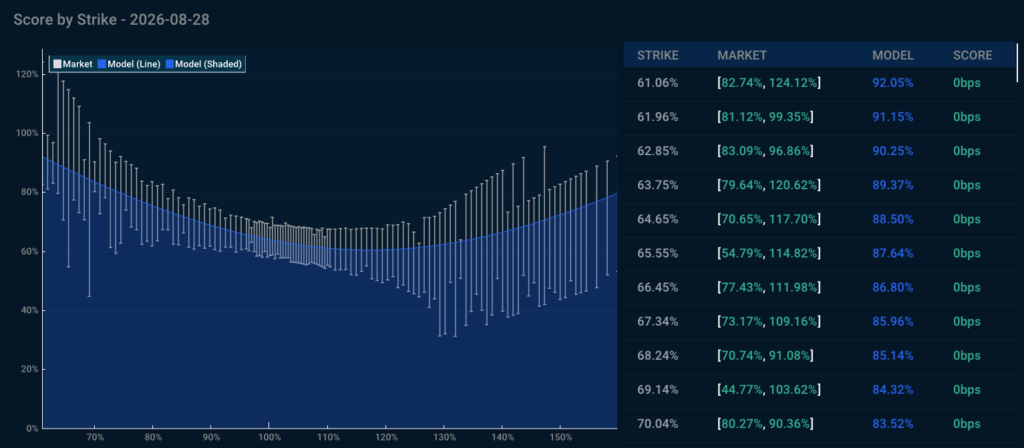
Integrated genOTC calibrated model volatility for SOXX options expiring Aug. 28, 2026, against quoted market bid/ask ranges. The model curve holds inside the market interval at every listed strike despite wide quoted spreads, with a deviation score of zero throughout. Image courtesy of Cegaware.
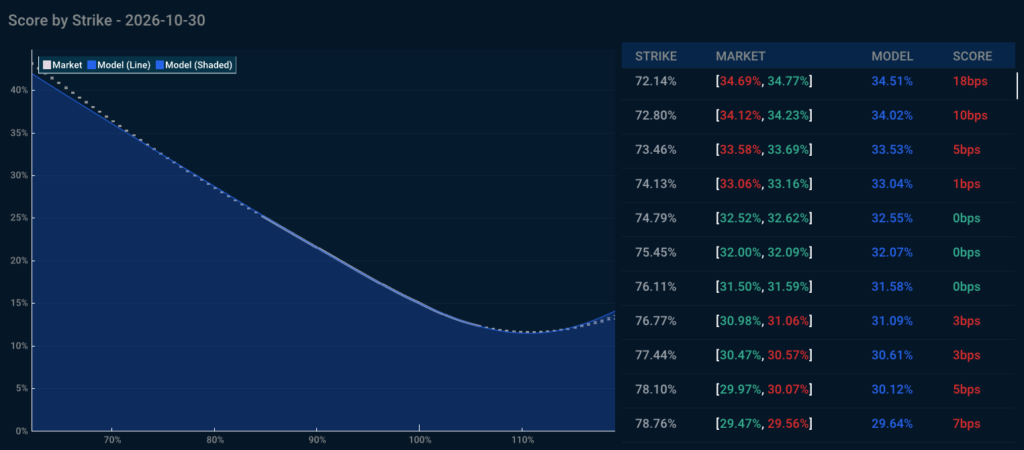
Integrated genOTC calibrated model volatility for SPY options expiring Oct. 30, 2026, against quoted market bid/ask ranges. Quoted spreads at the listed strikes run roughly 8 to 10 basis points wide; deviation scores peak at 18 basis points at the deepest listed downside strike and drop to zero near 75%. Image courtesy of Cegaware.
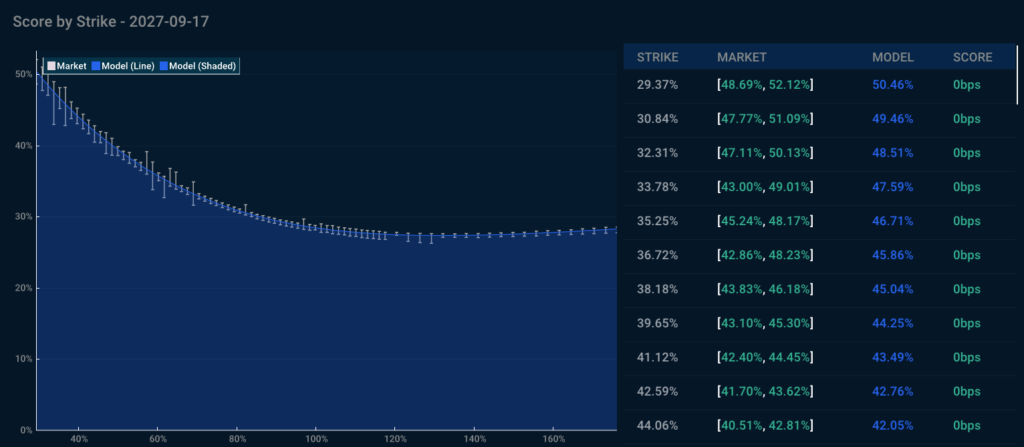
Integrated genOTC calibrated model volatility for AAPL options expiring Sept. 17, 2027, against quoted market bid/ask ranges. The model curve holds inside the market interval at every listed strike, with a deviation score of zero throughout. Image courtesy of Cegaware.
genOTC recovers the volatility surface from market data directly using optimal transport, with no-arbitrage enforced inside the optimization, not checked after the fact. No parametric shape is imposed on the smile, so there is no rigidity to pay for the guarantee. And because the model makes no asset-class specific assumptions, the same calibration model serves equities, FX, crypto and more via one engine, versus the typical approach of one engine per underlying type.
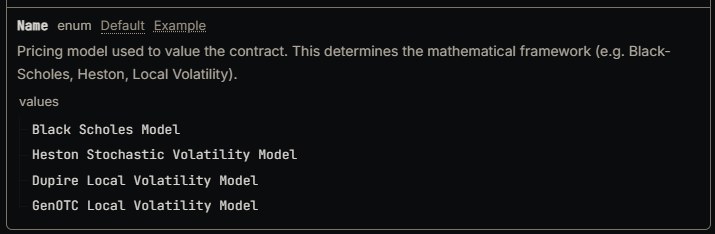
Cegaware API integration showing the available pricing models: Black-Scholes, Heston stochastic volatility, Dupire local volatility, and genOTC local volatility. Image courtesy of Cegaware.
That cross-asset design is what lets the integration land in Cegaware’s infrastructure in a single step. Cegaware routes every asset class through one calibration point once the forward curve is built, and genOTC is the kind of engine their socket was waiting for. The adoption itself was just as clean. Asked what an external technology needs to look like to fit their setup, the Cegaware team points first to documentation: “The documentation was clear, required no further clarification, and the integration was smooth.” The same interface Cegaware integrated is the one any client integrates: a documented REST API, callable from whatever sits above it. Calibration runs on the fly at pricing time: a user books a contract, confirms, and price and Greeks return within moments.
Every genOTC run launched from Cegaware is recorded with date, ticker, and UUID, so any valuation traces back to a specific, identifiable calibration, with an audit trail ready for regulators and counterparties. And clients can schedule daily automated checks, repricing forwards, options and rates instruments against the market, with alerts if a mismatch exceeds a defined threshold. What changes on the screen answers the question this article opened with. Cegaware ships a built-in view that visualizes arbitrage violations and market fit for any calibration model, so a user who selects the genOTC model can inspect its quality directly and compare it against the alternatives.
With a legacy platform, you have to trust the black box,” the Cegaware team says. “With us, you verify, and genOTC is why the verification holds.
The ambition behind the partnership: “ With Cegaware we have the ambition to provide institutional-grade pricing. There is no compromise on calibration quality. That is why the calibration layer is genOTC.”
To learn more about Cegaware:
Website: https://www.cegaware.com/
LinkedIn: www.linkedin.com/company/cegaware